
Building Character
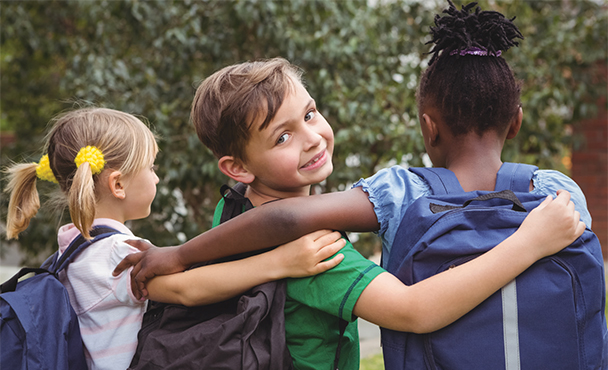
Education that Goes Beyond Academics
By Sheila Cosgrove and Daniel Beauregard
For many parents, a good education means much more than academics. While reading, math and science are all important, having their child learn about such values as kindness, respect and empathy for others is just as important, if not more so. Fortunately, most Atlanta-area public and independent schools incorporate some form of character education in their curricula, placing an emphasis on guiding children to become caring, involved members of society.
In fact, the state of Georgia devotes an entire month to the importance of character. Back in 2012, a group of students and teachers at Cobb County’s Durham Middle School wrote their state senator proposing that the little-known Georgia History Day be changed to a day that honored character and good choices. Gov. Nathan Deal extended the idea to a whole month, signing a law that set aside the month of September as Georgia History and Character Month.
As such, different public school systems in metro Atlanta integrate character education into their ongoing curricula.
At Kennesaw Mountain High School in Cobb County, students get together with local leaders on a monthly basis to learn character and leadership skills. Smith-Barnes Elementary School in Henry County focuses on a different character trait each month, such as respect, kindness, loyalty and self-control, and recognizes students who personify these traits.
Atlanta Public Schools emphasizes character education by making social emotional learning (SEL) a key focus of its curriculum. SEL is “the process through which all young people and adults acquire and apply the knowledge, skills, and attitudes to … feel and show empathy for others, establish and maintain supportive relationships, and make responsible and caring decisions,” according to the website for the Collaborative for Academic, Social and Emotional Learning.
A Larger Perspective
That approach is similar to the one taken by the Atlanta International School (AIS), an independent school in Buckhead that builds its curriculum around the framework of the International Baccalaureate (IB) program, preparing its students to engage with the world with intercultural understanding and respect.
This type of foundation often begins early. The Personal Social Education component of the Early Years program equips young learners with the language and strategies to approach social and emotional challenges thoughtfully. In addition, AIS’s renowned language immersion programs—offering instruction in English, French, German, Spanish, and Chinese—enable students to develop linguistic fluency and cultural awareness from the earliest stages of learning. As they progress, each grade’s IB curriculum integrates goals that promote communication, open-mindedness, and intellectual curiosity. The school also emphasizes independent thinking and respect for differing perspectives. Students are regularly exposed to multiple cultures and worldviews, learning to engage thoughtfully with ideas and opinions that differ from their own.
At McGinnis Woods School in Alpharetta, which serves infants through eighth-graders, students have character education classes with a counselor each week. The classes start in pre-K, with subjects such as how to be kind, how to resolve an issue and how to deal with others who are not kind, says Principal Mary Johnson.
“With our older children . . . we’ll go into things like digital safety so they will not say things on social media that are rude to others or inappropriate, being mindful of those things because they can stay there forever,” she says.
The school also promotes character education through its morning announcements, which include the character word of the month, and by honoring a student as a Citizen of the Month for exhibiting strong character traits.
At the Galloway School, an independent school serving children from age 3 through high school, the early learning program focuses on a different value each month. “In October, our value is empathy,” says Early Learning Counselor Dana Eisenman. “The lessons we’re teaching in social emotional learning are focused on empathy, highlighting how different people in our community exemplify that. And we recognize those students and faculty members who exhibit the different qualities of the value of the month.”
Galloway school students also put their character education lessons into practice, beginning at a young age. “We recently had our pre-K students partnering with the middle learning students to create posters for food donations for Meals on Wheels,” Eisenman says. “Last year, our second-graders had a food insecurity unit and partnered with Backpack Buddies,” a nonprofit that provides kids with nutritious weekend meals.
Respecting Differences
Learning to respect the viewpoints of others is a key component of character-based education. At AIS, the Galloway School and other schools, students are exposed to other cultures and different viewpoints, and learn to value others’ opinions, even when they don’t agree with them.
“We work a lot with flexible thinking, the ability to think about things in new and different ways,” says Eisenman, “and how you can use that to see different perspectives. One thing we emphasize a lot is that you don’t always have to agree with the other person, but you have to understand their perspective. And we also do what we call perspective taking, where we look at characters in popular books, movies or other media, and talk about how the same situation could look different depending on whose perspective you’re looking at it from.”
Woodward Academy, an independent school serving pre-K through high school students on two metro Atlanta campuses, takes SEL one step further with its SEE (social, emotional and ethical) Learning program. Developed by the Center for Contemplative Science and Compassion-Based Ethics at Emory University, the program exposes students to different viewpoints and helps them to develop traits like compassion and resilience that will serve them throughout their lives.
One example of this, says Jennifer Knox, Woodward’s director of character education and the Ron M. Brill chair of ethical leadership, is the program’s focus on helping students learn to look at themselves and try to remain calm in high-stress situations.
“We look at what’s going on that relates to emotions, to the brain, to navigating those,” she says. “How do we recognize those? How do you respond when an emotion becomes difficult?”
Whether you choose a public or independent school education for your child, there are options throughout the metro Atlanta area that seek to help prepare them for the future not just academically but as a person of good judgment and character, as well.